


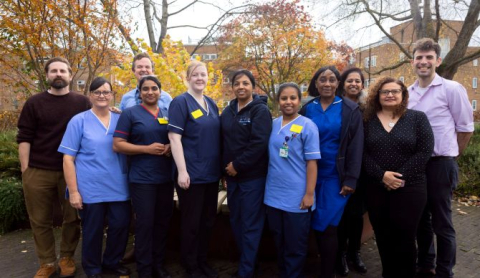
Transplant specialists at Harefield, Guy’s and King’s College hospitals have collaborated on a new process that will make more donor hearts and other organs available for transplantation each year.
The new process enables organs infected with hepatitis C to be safely transplanted into a recipient. As a result, a patient at Harefield Hospital is the first person in London – and at Guy’s and St Thomas’ NHS Foundation Trust – to receive a heart transplant from a hepatitis C positive donor.
The collaboration between cardiothoracic specialists at Harefield, nephrology specialists at Guy’s and hepatology specialists at King’s – all part of the King’s Health Partnership – means people waiting for a heart, lung, liver or kidney transplant may now have access to more donor organs.
Hepatitis C is a bloodborne virus that can severely damage the liver if untreated. Until recently, most organs from hepatitis C positive donors were discarded due to the high risk of transmission and limited treatment options. But with modern antiviral therapies now able to cure hepatitis C, these organs can be used safely.
Recent data suggests using hepatitis C positive organs could lead to up to 75 additional organ transplants in the UK each year.

Heart transplant patient Mark Bromage, 64, a former insurance executive, was the first recipient of a hepatitis C positive heart in London, and only the fourth in England.
Mark said: “I had a mild heart attack in February 2023 and then in May 2024 I had another one which severely damaged my heart. I was eventually transferred to Harefield where after many tests and scans, my Christmas Day gift was to be put on the waiting list for a new heart.
“The mental stress when you prepare for a transplant and are told the organ isn’t suitable is painful. I went through this three times.
“Then in February, my consultant said there was a heart and it was a match, but I should be aware the donor was positive for hepatitis C.
“For me, it was an easy decision to accept it. I had every confidence in my wonderful clinical team. They assured me the virus was easily curable if I contracted it after the transplant.”
Mark underwent the transplant earlier this year. He did not contract the virus and was discharged two weeks later.
He is now enjoying life post-transplant, volunteering in the Harefield Healing Garden, baking cakes for fellow volunteers, and even fulfilling his dream of flying in a Spitfire aeroplane.
Mark added: “I feel so lucky. I have a positivity and zest for life that helps me make the most of every day. I get out walking with the dog every morning for an hour – I love it. I've also become a baker. I don’t know why, as I never baked before!”
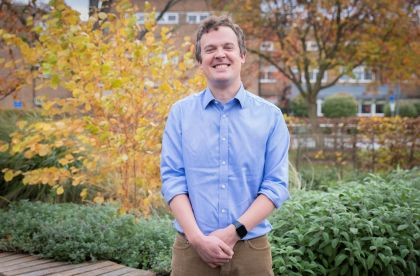
Dr Andrew Morley-Smith, transplant cardiologist at Harefield Hospital, said: “Thanks to the collaboration between our hospitals, our transplant and surgical teams were equipped to manage every eventuality with Mark’s transplant. We were able to provide him with information and reassurance from the start. And if he had become infected with hepatitis C, we had quick access to the medication and specialist consultants at King’s who would support us to treat it immediately.
“In the UK, transplanting hepatitis C positive organs is relatively new. Making it happen requires access to a complex combination of specialist knowledge and medication. I am proud our teams worked together to facilitate this. It means the pool of donor organs could become larger, which is good news for our patients who are on the waiting list, and especially critical for patients like Mark, who are waiting for a heart.”
The new transplant process will also benefit patients at Harefield awaiting lung transplantation and Guy’s who are waiting for kidney transplants.

Dr Rachel Hilton, Consultant transplant nephrologist at Guy's Hospital, said: “Now that we can accept organs from donors who are positive for hepatitis C, the likelihood of a match for our patients is higher.
“People who need a kidney transplant are often on dialysis, which can be very tough to live with. So it is fantastic that some of our patients could now come off the waiting list for a new kidney more quickly.”
Dr Kosh Agarwal, clinical lead for viral hepatitis for King’s and the South London region, added: “I am delighted to have collaborated with colleagues across our hospitals by providing our expertise in hepatology. Supporting innovative transplant solutions is incredibly important for our patients who are seriously unwell, and this is an exemplar of how we can deliver life-changing patient benefits by working together.”
Transplants are not possible without the generosity of families who consent to organ donation. To register as an organ donor, visit www.organdonation.nhs.uk
Contact information
If you're a journalist and have a media enquiry, please contact us.
Phone: 020 7188 5577
Email: gstt.press@nhs.net